Compact rooms are usually blamed on their size, when the real issue is how much they are being asked to do. A small bedroom often doubles as a home office, a spare room becomes a storage overflow, and a narrow living room has to hold seating, media, toys and everything waiting to be put away. The room is not too small in absolute terms — it is simply carrying more than its share of the household's demands. Once you accept that, the improvements become clearer: you are not fighting the walls, you are renegotiating what belongs in the space and how visible it needs to be.
The advice in this guide comes from rooms we have worked in where a full remodel was not necessary and not wanted. Sometimes the honest recommendation is to spend a modest amount on lighting, paint, mirrors and storage rather than knocking through a wall, and to see how much difference that makes before committing to structural work.
Start with light, because everything else depends on it
Before changing a single colour or buying a piece of furniture, spend a day noticing how light moves through the room. Where does the sun land in the morning? Which corner stays dim all afternoon? Is the window blocked by furniture, curtains that do not fully draw back, or a heavy roller blind that is permanently half down? Simply moving a sofa away from a window, or swapping a bulky curtain pole for one that extends past the frame, can release more usable daylight than any paint choice.
Then look at the layers of artificial light. A single ceiling fixture in the middle of a small room flattens everything it touches and casts shadows into the corners, which makes the space read as smaller. Replacing it with a trio of smaller sources — a wall light, a floor lamp, a small table lamp — spreads brightness to the edges of the room and gives the eye somewhere interesting to travel. Warm bulbs matter here too; a harsh cool white can make even a well-proportioned room feel clinical, while a softer warmth makes the same space feel inviting and, oddly, more generous.
Choose colour that wraps rather than divides
There is an old assumption that small rooms must be painted white. White certainly helps by reflecting light, but a cooler white in a north-facing room can tip into grey and leave the space feeling chilly rather than airy. A better approach is to choose a soft, warm neutral for the walls and then carry something close to that same tone onto the ceiling and woodwork. When the wall, ceiling and trim sit within a narrow range of tones, the corners stop reading as hard edges and the room feels continuous instead of boxed.
If you want contrast, spend it on one deliberate feature rather than scattering it around. A deeper shade behind a bedhead or on a chimney breast pulls attention to a single point and adds depth. Accent colours work best when they repeat — a cushion, a ceramic pot, a book spine — so the eye registers a scheme rather than a series of unrelated objects. Too many competing colours in a compact room will always make it feel busier and, ultimately, tighter.
A small room does not need to be emptied to feel bigger. It needs to be decided, so that every item in it has an obvious reason for being there.
Use mirrors and glass with intention
Mirrors are the most reliable tool available in a small room, provided they are positioned to reflect something worth seeing. A mirror facing a window will bounce daylight deeper into the space; a mirror facing a blank wall will simply show you a blank wall, only brighter. The best placement is usually on a side wall or opposite a window, angled so that the reflection carries light across the room instead of glaring into your eyes.
Glass furniture behaves in a similar way by letting light pass through rather than blocking it. A glass-topped side table, a slim console with an open frame, or a shelf of transparent containers will all take up floor space without weighing the room down. The trade-off is that glass needs to be kept clean, which is why we rarely recommend it in homes with very young children or pets — practicality has to come before aesthetics.
Scale furniture to the room, not to the house
Oversized furniture is the quiet reason many small rooms feel cramped. A deep sofa looks luxurious in a showroom but can swallow the floor of a narrow living room, leaving nowhere to walk and no place for a lamp. Measuring the room and marking furniture footprints on the floor with tape before buying is a habit worth adopting — it takes a few minutes and prevents an expensive mistake.
Look for pieces that lift the floor: sofas and chairs on slim, visible legs create a sense that light and air pass underneath, which makes a room feel less packed. Dual-purpose furniture is valuable too, but only where the dual purpose is genuinely used. A storage ottoman that holds blankets is excellent; a fold-out bed that is opened once a year may cost you floor space for the other three hundred and sixty-something days.
Control clutter with a home for everything
Clutter is the fastest way to shrink a room, and it accumulates because objects lack an agreed place to live. Instead of buying more boxes, decide where each category belongs: keys and post at the entrance, charging cables in a drawer, paperwork in a single vertical file, toys in a low unit a child can reach themselves. When something has a home, tidying becomes a short routine rather than a project.
Vertical storage is usually the answer in small rooms because it uses height that would otherwise be wasted. Shelving that runs up a chimney recess, a slim cabinet above a washing machine, hooks on the back of a door — none of these take floor area, and together they can remove the pile that has been sitting in the corner for months.
Keep sightlines low and clear
When you sit in a small room, notice where your eye travels. If a tall wardrobe, a bookcase and a coat stand all sit in the middle of the visual field, the room will feel divided and narrow. Lower furniture around the edges, and keeping the central line of sight clear from the door to the window, makes a compact space read as one continuous room rather than several tight pockets.
Curtains hung close to the ceiling and slightly wider than the window frame also stretch the apparent height of a wall, while a rug that sits partly under the main furniture will visually gather the seating area together. Bare floorboards with a small floating rug usually make a room look more fragmented, not less.
Make the finishing details deliberate
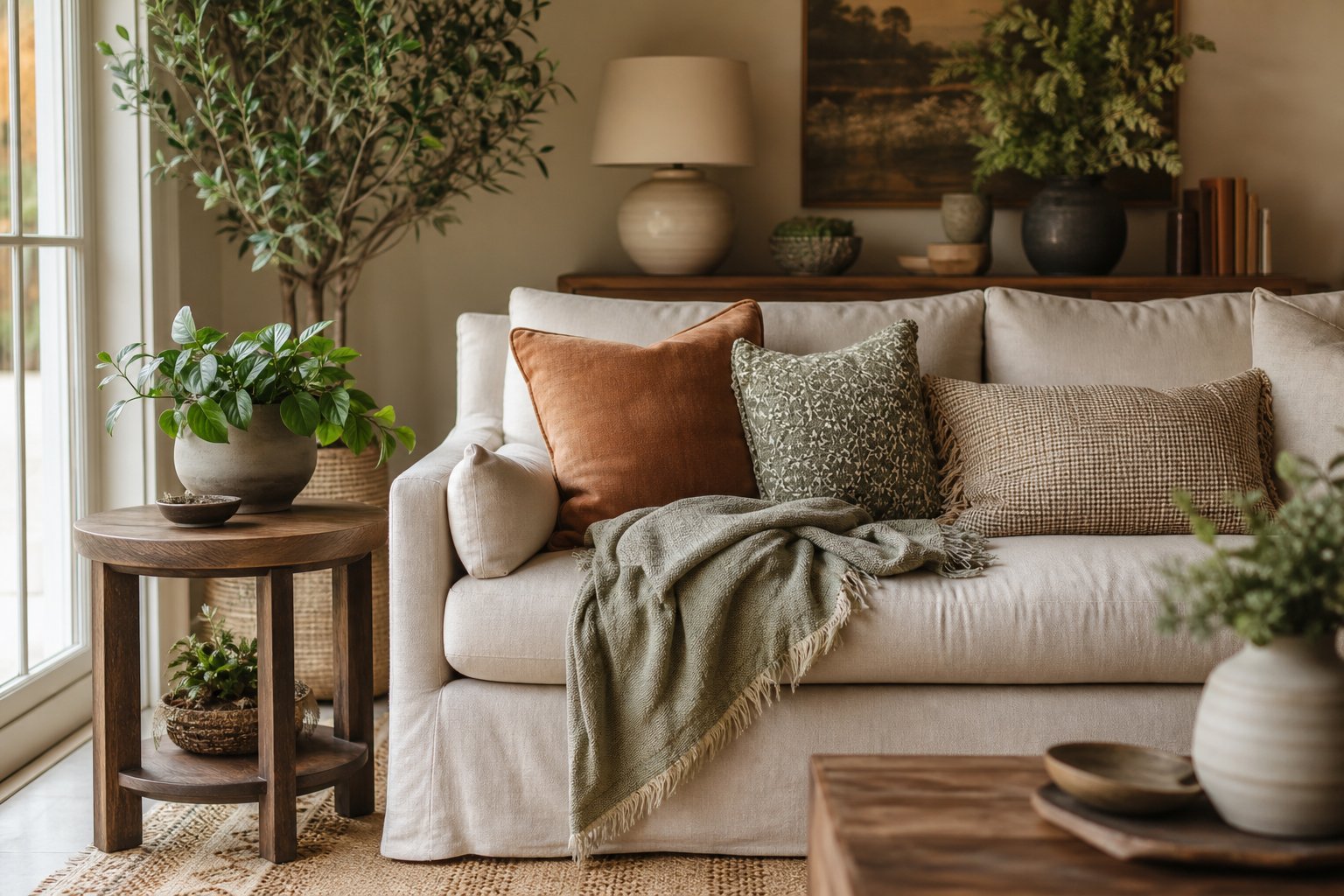
Finally, consider the details that punch above their cost: handles and knobs that match throughout, a neatly trimmed plant instead of three struggling ones, a single piece of art placed at eye level rather than a cluster of small frames, and cushions that pick up the accent colour you chose deliberately. These are the items you touch and look at every day, and getting them right is what turns a tidied room into a room that feels finished.
If you take only one thing from this guide, let it be that small rooms respond best to consistency. Consistent lighting warmth, a consistent tonal range, consistent storage and a consistent accent colour will almost always beat a series of individually attractive purchases. And if you get to the point where the room still feels constrained — usually because the layout, the window position or the storage is genuinely limited — that is the moment to call us. We can tell you whether a modest intervention will do, or whether it is time to plan something larger.